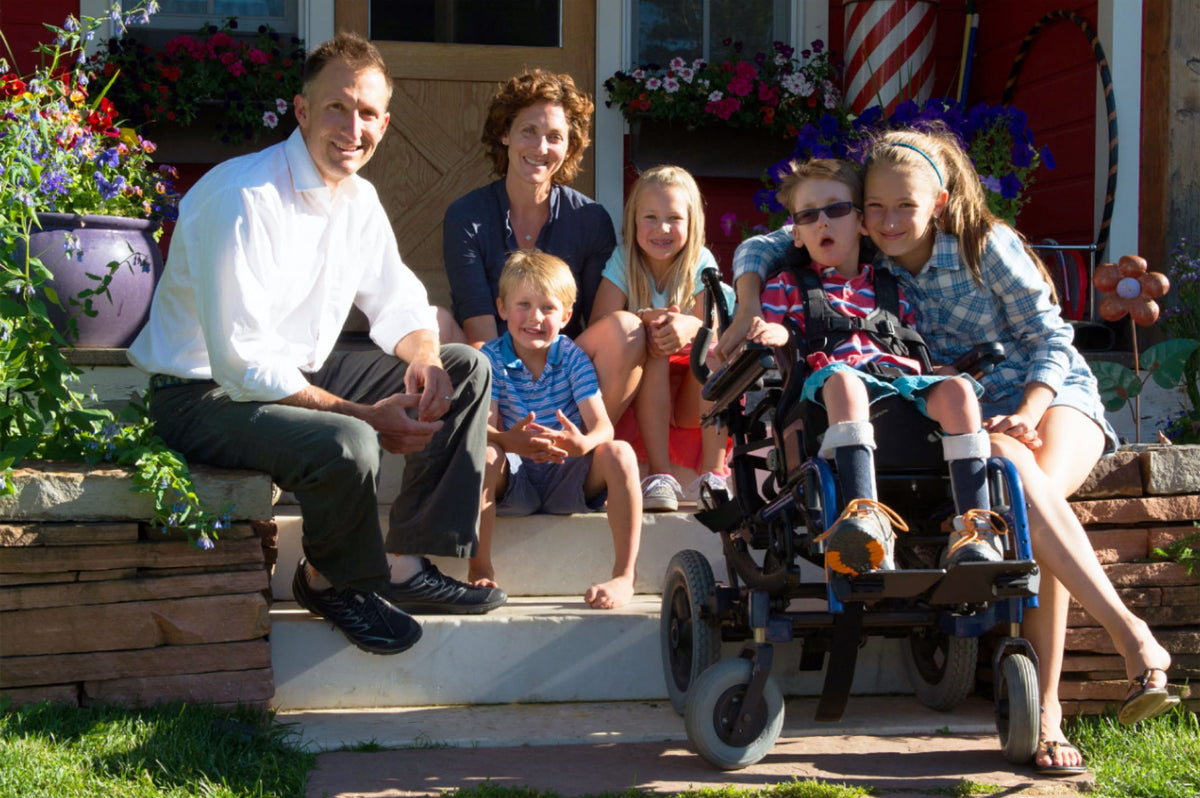
Jackson’s Story
My husband and I are often asked how it is that we came to be in the potato chip business. It is, after all, an odd business for a mom and pop start-up (or any start-up for that matter) given that it’s dominated by major global brands that have a stranglehold on everything from the farmers that grow potatoes to the grocery stores that sell the finished chips. As you might imagine, it’s not out of any misplaced business confidence that we could possibly compete with the big manufacturers. Rather, it is a very personal reason with a complex backstory.
Our first child – Jackson – was born in May 2001 as beautiful and healthy as can be. Like all first-time parents, we were simultaneously overjoyed and exhausted, elated and anxious. When we took Jackson home from the hospital, my husband drove 15 miles per hour through the streets of Denver, Colorado, because we were so worried about other drivers, potholes, pedestrians, etc. We were blessed enough for me to stay at home to take care of Jackson and, as the days and nights passed, my husband, Jackson and I got into a wonderful groove with sleeping, eating, and working. Summer’s long walks with Jackson and our dog Scout through Washington Park in Denver gave way to fall, winter, and spring walks as we all watched the seasons change. Jackson’s first birthday was celebrated with birthday cake, pictures, and friends; over the next several months Jackson took his first steps and spoke his first words. I was also pregnant with our second child, Ella, who arrived in December 2002. We had become a great little family unit.
However, starting in late fall 2002, ever so subtly, Jackson’s legs started getting weak; he’d prefer to crawl rather than walk; his weight gains started to slow; he started getting fussy with stomach pains and unusual bowel movements. Our first pediatrician dismissed our initial concerns entirely and when Jackson’s symptoms started getting worse over the next three months – weight loss, difficulty standing, greater stomach discomfort – we switched pediatricians and sought a second opinion.
Over the next 18 months Jackson’s condition became steadily and inexorably worse. We watched helplessly as Jackson’s weight started to drop, his gross and fine motor skills became more and more diminished, and his stomach and digestive symptoms became debilitating. Between his second and third birthday, he hardly slept for more than a few hours at a time; his muscle spasticity became so profound that he could not speak, feed himself or sit upright. As he turned three years old, he started to have significant difficulty swallowing food or drink on his own.
Over that time, we saw specialists in nearly every field of pediatrics: metabolics, genetics, gastroenterology, immunology, infectious disease, neurology, and rheumatology. Jackson had spinal taps, CT scans, x-rays, electroencephalograms, and MRIs; he had his blood, urine, stool, and spinal fluid analyzed and then re-analyzed. We exhausted every medical resource in Colorado and traveled to or consulted with specialists from Children’s Hospital Boston, Johns Hopkins, The Mayo Clinic, Children’s Hospital Philadelphia, Columbia University Medical Center, Baylor University Medical Center, Children’s Hospital UCLA and researchers in Manchester, UK and Lyon, France. We traveled from Palo Alto, California, to Boston, Massachusetts, and many points in between to meet with any doctor or researcher that would agree to look at Jackson’s medical file. We explored Chinese medicine and homeopathy, functional medicine and herbal medicine, Reiki and Cranial-Sacral Therapy. We read every book we could on the most esoteric diseases; we subscribed to online medical journals and searched symptoms and keywords from articles and contacted their authors.
Despite these efforts, there were no leads, no insights, and no diagnosis. Inevitably, each meeting with a specialist, expert, or researcher would end with them apologizing, saying ‘good luck,’ and encouraging us to keep looking. So we did.
Although we had no idea what was causing Jackson’s spasticity, muscle weakness and paralysis, we felt like we should be able to help his digestive discomfort, which had become a source of profound suffering for him. Jackson’s gastroenterologist prescribed every type of medical food available; we tried elimination diets and supplements of all stripes. We had always eaten organic foods but that wasn’t something that mattered to Jackson’s condition either. Nothing seemed to help. He couldn’t sleep, he couldn’t eat, everything he ate caused him to writhe and whine endlessly, and he was losing weight fast.
Conditions went from bad to worse. Jackson suffered a severe bout of pancreatitis and his GI doctor suggested he be hospitalized for several days and put on an IV drip to allow his pancreas to heal and calm down. After two days in the hospital, Jackson’s pancreatitis got worse – something his gastroenterologist had never seen before. Instead of him gaining weight on the IV drip as we thought, Jackson lost yet more weight and did so more rapidly than when he was home. On our third day in the hospital Jackson weighed less than 17 pounds. He was three and half years old.
Distraught and realizing that Jackson wasn’t being helped by the IV solution he was being fed, we asked his doctor to release him so we could take him home. Jackson’s doctor was a kind and thoughtful man and realized that what they were doing was making things worse. We had no idea how we might cope with his pancreatitis or what his radical weight loss meant, but we knew staying in the hospital and being fed by IV was making things worse. We all agreed that we would check-in daily with his doctor and have his blood tested every other day to keep tabs on Jackson’s pancreatitis. His doctor gave us some morphine and told us he hoped Jackson’s transition went smoothly. Odds were not good that he would make it another two weeks.
Back home on our kitchen bookshelf was a cookbook that my husband had purchased a few months earlier that we had previously only skimmed. It was entitled “Nourishing Traditions,” written by Sally Fallon, and published with the help of the Weston A. Price Foundation, a nutrition education non-profit. Their philosophy seemed simple; eat nutrient dense foods as close to their original state (that is, unprocessed) as possible. Eat fermented foods that are more easily bio-absorbed. Eat ‘good’ fats.
In looking through the book in greater detail, we read a section on ‘feeding babies’. On page 603 of our edition of Nourishing Traditions was a recipe for a ‘meat-based formula’ for babies that consists of homemade beef broth, beef liver, lactose, and a spectrum of healthy fats in the form of cod liver oil, coconut oil, unrefined cold-pressed sunflower oil and extra virgin olive oil, all blended together. We had tried far more esoteric diets for Jackson, so one that was so heavily laden with fat and protein didn’t seem like much of a stretch for us. And besides, we – and Jackson – were desperate for relief. With Jackson weighing 17 pounds at 3 ½ years old, the term ‘nutrient dense’ seemed like an idea worth trying. We had exhausted every other possible combination of foods, both medical and over-the-counter.
Within a week of being on Sally Fallon’s meat-based formula exclusively, Jackson started sleeping better, crying much less, and his pancreatitis started to recede. We started to believe this might help. Within two weeks he slept through the night on occasion – for the first time in at least two years – and his weight started to stabilize. Within a month he actually put on a small amount of weight and his pancreatitis was all but gone. We had been fully converted. His condition stabilized more and more as the weeks and months went by.
We weren’t looking for a cure to our son’s undiagnosed disease – we were simply trying to make his quality of life much better. And we were able to do so by changing – radically – his diet. In fact, food was the only thing in three years that was able to intermediate in any way in his disease: good fats, grass-fed meats, fresh and fermented vegetables – these were the things that gave us hope that we could somehow change the terrible trajectory that Jackson’s life had taken. We let out a breath that we’d been holding in for nearly three years.
Jackson is 12 years old now, confined to a wheelchair and still unable to speak, eat or sit by himself. And though his disability still presents many challenges, he is happy, sleeping though the night, and doing everything a wheelchair-bound boy of 11 does with his two younger sisters and brother. For the past seven years we have stabilized whatever disease process was underway exclusively through a nutrient-rich diet of healthy fats and proteins. That feels to us like the miracle it is.
Once Jackson started to respond so well to this diet, we started asking ourselves why. My husband graduated with a degree in chemical engineering, so he started studying the chemistry of lipids and their biological importance: how they react in and with the human body. We soon realized that almost everything we had learned about fats was quite wrong – or at least massively distorted. We realized that traditional, healthy fats that nature ‘intended’ (cod liver oil, tallow, lard, coconut oil, unpasteurized butter from grass-fed cows, etc.) were a source of
essential nutrition. And that man-made vegetable oils that are the product of an industrial manufacturing process that was unavailable to human beings prior to the late 1800s were a source of real nutritional aggravation.
As we embraced this healthy fat diet over the last 7 years, we came to incorporate pastured butter, lard, and coconut oil in more and more of our foods. And as our family grew to four children, we started experimenting more with making everything they ate Weston A. Price and/or ‘Paleo’ friendly. Perhaps, inevitably, we experimented with frying our own potato chips in coconut oil. Like many families, we had never had a ‘proper’ potato chip – one fried in traditional cooking oil like lard, palm, or coconut oil. So we gave it a try one weekend.
And we couldn’t believe the difference in flavor. Our coconut-oil chips tasted like an actual potato – rich, deep, aromatic. The combination of the light, almost sweet coconut oil, the earthy potato, and the dash of sea salt made for a wonderful combination of savory, salty, and crunchy. Our kids instantly became fans.
Naturally, we started making loads of them: for our kids’ lunches, for picnics, for holidays, for barbecues, for hikes, for skiing, for dinner. Every chance we had, we would make some chips and they became a great way to get coconut oil into our diets. We realized that if a healthy fat like coconut oil could work wonders for Jackson, then certainly it could be beneficial for our other kids too. Over the last few years, friends, neighbors, and family started to eat our chips at picnics, dinner parties, and holidays. They all remarked on how fresh and tasty they were – how they tasted like a real potato, and many said “You should sell these!”
Initially we scoffed at the idea of selling them. My husband’s travels for his job and my raising our four kids kept us from having the time to even contemplate that. But over time, enough people kept saying that we should sell them that we actually gave it some thought. Making our own potato chips at home was a time-consuming and labor-intensive process: how could we possibly make enough to sell? How would we compete when the global brands who dominate the business have billions of dollars in advertising budgets? To be honest, we often wondered if there were families out there like ours who understood the difference between a healthy traditional fat and the industrially manufactured vegetable oils. But we only came to appreciate that through Jackson’s disease. Surely the total number of people who wanted chips fried in an oil other than canola, sunflower, safflower, corn, cottonseed, or soy oil was minuscule, right?
As we pondered whether or not to sell our potato chips, our minds raced with the difficulties of doing so: the competition, the logistics, the regulatory barriers, the distribution and supply chain complexities, the costs both in time and treasure. Start-ups are notoriously difficult even in the best of times: Jackson’s Honest Potato Chips would be even more difficult.
So what really made us decide to start selling potato chips fried in a healthy fat? A debt of gratitude.
We feel that healthy fats changed the course of my son’s life. In fact, I believe that healthy fats saved Jackson’s life. Our debt of gratitude to Sally Fallon, the Weston A. Price Foundation, as well as the Paleo diet movement can never be repaid. But we can do something. And that something is to promote the use of healthy fats in a food that 85% of all Americans eat at least once every three weeks. As the nation’s most popular snack food, potato chips are a great vehicle to change the world one lipid at a time. We cannot possibly know if providing potato chips fried in coconut oil will have any real impact on the snack food industry or on any specific family or child. My family consumes lots of healthy fats in a great variety of foods. Lamentably that is not the case for many Americans. Perhaps potato chips are the Trojan horse in a campaign for re-introducing real fats into the American diet.
It was only after we stopped thinking about selling potato chips as a business that we came to an important appreciation. Jackson’s Honest Potato Chips isn’t a business, it’s a movement: a movement to re-introduce healthy fats into the food chain. We’re starting with potato chips because potato chips are eaten by more Americans than any other snack food by far. If we are blessed with success, there are tortilla chips, pretzels, and many other packaged goods that could benefit from the addition of coconut oil or other healthy fats to their recipes.
If there is even the smallest chance that the re-introduction of coconut oil into the potato chip industry could – through education about fats via our labels, our Facebook page, or our website – alter the course of someone’s life then we owe it to ourselves, to them, and to Jackson to give it a try. Who knows what the ripple effects of this process might be; if it spurs other companies to offer other products using healthy fats, so much the better. So to us, Jackson’s Honest Potato Chips is not so much a business as a payback; it is our debt of gratitude.
As for Jackson, well, we still don’t know what disease he has. His condition – whatever it comes to be named – is stable thanks in large part to his diet. And for that we are blessed. As importantly, we have an endless reservoir of hope that advances in medical technologies will help us solve this riddle in time now that he is stable. He was recently accepted into the Undiagnosed Disease Program (UDP) at the National Institute of Health (NIH). The UDP tackles the hardest-to-diagnose disorders, relying on NIH specialists in endocrinology, immunology, oncology, dermatology, dentistry, cardiology, genetics, and other areas to come up with insights about each case. And one of our long-term goals as a business is to dedicate a percentage of profits from the sale of Jackson’s Honest Potato Chips to the Children’s Hospital Colorado, our local hospital that has been a valuable resource for us. If our monetary contributions to the Children’s Hospital can help reduce the suffering of other parents who experience the haunting uncertainty that comes from not having a diagnosis for their child’s disease, then we will have accomplished a great deal indeed.
Thank you for your interest in our story, in our chips, and in the healthy fat ‘movement,’ We have found great encouragement in the many orders and well wishes we have received from England, Canada, Australia and a great many different US states. We will do everything we can to make as many chips as are ordered. Please help us to spread the word about Jackson’s Honest Potato Chips and healthy fats!